WHAT BOMBS COULD NOT DESTROY:
MY HEART IN GAZA
By Noora AbuHamad
We were driving across the Sinai desert – a vast landscape of sun-bleached sand and soldiers with guns. Seven hours into our journey, authorities stopped our vehicle for the fourth time. In the scorching August sun we were ordered to exit our vehicle and unload all our 17 suitcases. Exhausted, we paraded our packaged lives through the checkpoints to be searched and questioned yet again.
We were travelling somewhere that the British government had advised against going to for more than a decade and that is where I’m from:
Gaza – a place in Palestine struggling to exist
My parents, my four younger siblings and I moved to Gaza in August 2023 to be with our grandmother, aunts, uncles and 30+ cousins. This was a family we rarely were able to visit due to the Israeli occupation. My father’s family is native to Gaza; they have been farmers and traders in Gaza for generations and over centuries. My family owned their land and built ancestral homes, unlike 70% of the population in Gaza who are refugees from inside what is now Israel. These Palestinians have been confined to refugee camps in Gaza since 1948 – unable to return to their homes in the erased towns and villages beyond the militarized border.
When we arrived at our home in Gaza, my extended family and neighbors were so joyful and welcoming, knowing the struggles people faced to enter Gaza. My family all resided in the same neighbourhood, so our evenings were full of laughter, food, and games with our cousins.
By September, we had unpacked and furnished our house, putting in new desks and chairs and a bunk bed for my twin brothers. My siblings and I started at the only British school in the territory, making a daily 30-minute commute to Gaza City.
The destroyed buildings and the craters we passed on the drive to school were not remnants of the distant past but part of the occupiers’ policy of “mowing the grass’. This euphemism refers to Israel’s cyclical bombing of Gaza every few years since imposing a blockade on the strip in 2007, the year before I was born.
We only had access to electricity 6-8 hours a day, so the lights would turn off in the middle of dinner, the fan turned off during the hot nights and the running of the washing machine was unpredictable. Our school textbooks never arrived due to the Israeli blockade, but teachers still taught and we still learned.
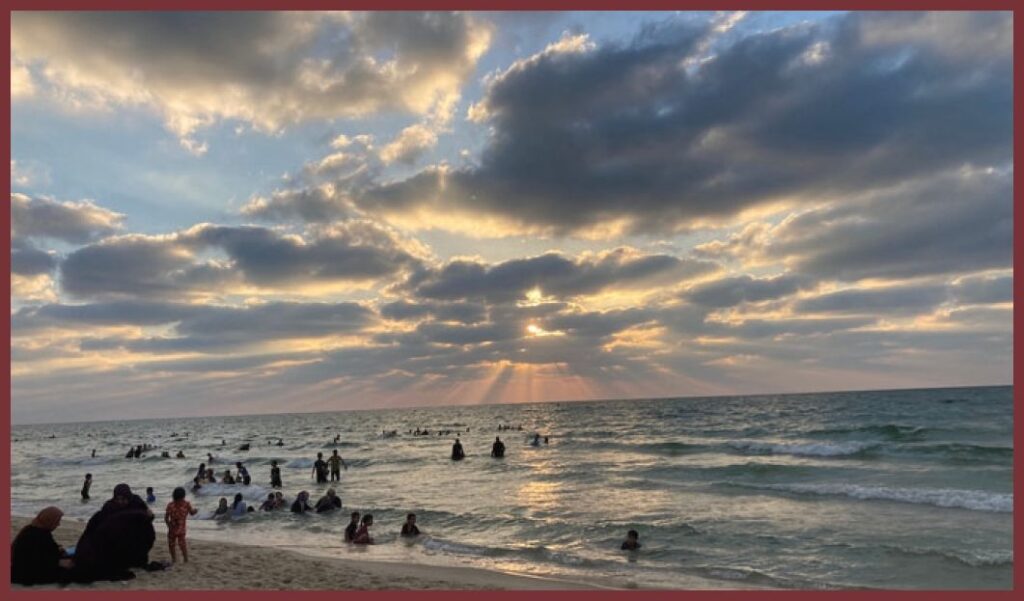
The beach was our favourite place to escape and only a few miles west of our home. However, reminders of the Israeli occupation were never far away. After sunset, the lights from Israeli military ships lined the horizon, silent watchmen ensuring Palestinian fishermen did not venture far for their catch. If they fished too far from the coast, they risked being shot.
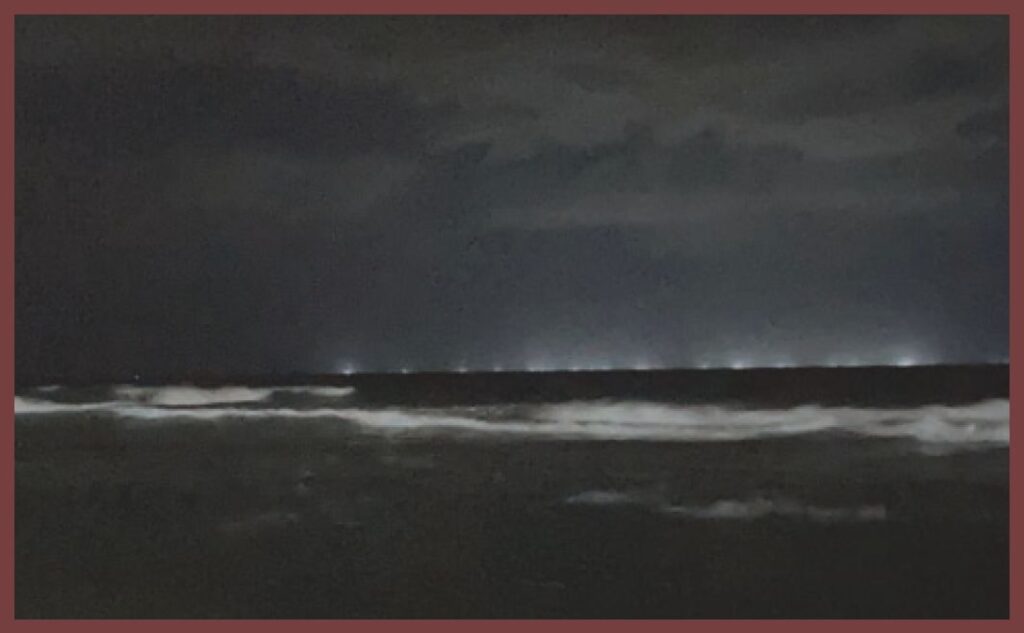
These patrolling ships, the crowded refugee camps, my struggles across the Sinai, and the constant power outages were examples of the many ways Palestinians’ lives are controlled from afar by a faceless army, lacking the freedom I barely noticed growing up in Manchester.
Most Gazans have never tasted such freedom as they cannot travel for medical care, work opportunities, or studies outside Gaza without permission from the Israeli or Egyptian authorities, which was rarely given. Similarly, no one without a Palestinian passport can come to visit the territory without such permission.
Still, despite these restrictions, life in Gaza was relatively normal on October 6th.
As I relaxed with family and planned for the upcoming bake sale at school, I could never have imagined that everything could change so quickly – how this was the last calm night before a relentless two years of destruction that would kill tens of thousands of civilians and destroy 90% of all buildings in Gaza.
The next morning, we woke up to a sky filled with the sound of deafening rockets, the air thick with confusion, and an ominous, overwhelming sense of fear and dread settling over us. For years, Palestinians have peacefully protested and endured their muted existence. They have created powerful art, music, and literature that travel far beyond Gaza’s borders and used social media and citizen journalism to document daily life under siege – speaking directly to global audiences.
The most significant effort was the Great March of Return (2018-2019), a series of large peaceful protests where thousands of Palestinians gathered every Friday near the border fences and demonstrated – demanding freedom and the right to return to their original homes beyond Gaza. Israeli snipers responded with live fire, killing over 200 people and injuring more than 8,000, including children, medics, journalists, as well as demonstrators, according to the UK-based charity Medical Aid for Palestinians.
But these events, and Gaza’s worsening conditions, received little acknowledgment from international governments or mainstream media. So when October 7th happened, the world treated it as a beginning. For Palestinians, it was a continuation – and led to the intensification of the deprivation and bombardment that had defined life under blockade since 2007. That morning carried a deep sense of dread of the collective punishment coming for crimes we had not committed – knowing there was no way to protect ourselves.
I was in Gaza for the first month of what has become known as the first live-streamed genocide. Within 48 hours, on October 9th, our entire town was ordered by Israel to flee to other parts of Gaza and was bombed intensely soon after. I soon understood that my safety was never guaranteed. Because of who I was and where I was, I was not protected. Sealed in by borders and stripped of basic rights, my family and my home was not protected, even with a foreign passport and only being a child.
My family and I were displaced multiple times, constantly trying to figure out where to go with the main criteria being the place that is least likely to be killed. Ironically, no one really knew, we could only guess, and we soon learned that nowhere was safe -a horrifying reality that Palestinians were forced to accept and repeatedly testify to with their words and mangled bodies on the nightly news.
We first took shelter with a family in a town closer to the sea. Bombing became constant at night. I could hear distant explosions frequently and became terrified hearing aircraft pass overhead constantly. One evening, a missile screamed over the house as we ate dinner, rattling the house and causing nearby windows to shatter. We felt grateful to not be directly hit but later learned seven Palestinians were killed by that strike.
Days later, we moved again to a flat in a residential neighbourhood of low-rise tower blocks, away from the main towns. We stayed there with aunts, uncles, and cousins – 29 people in a three bedroom flat, with two bathrooms (both which became inoperable when the water supply ran out days later). Still, the consistent bombing found us.
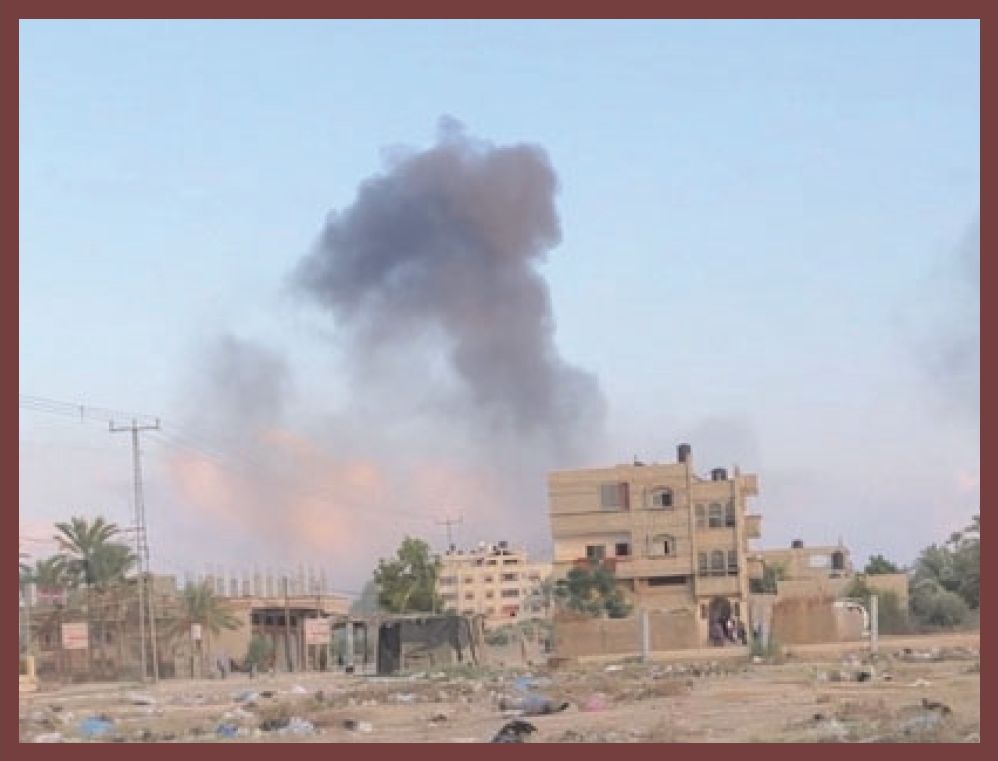
One evening a warplane shook the building as if it were right above us. Our conversations were cut off by the deafening roar of the jets, and we all stared at the ceiling. I silently begged for the sound to fade. I envisioned how it might feel for a bomb to vaporise me. Then I heard a voice and turned to see my aunt sitting quietly in the corner of the crowded space, looking forward – afraid, but calm.
I read her lips as she whispered an Arabic phrase that I would soon hear again and again stated by Palestinians in Gaza in the brutal months to come:
“God is sufficient for me, and He is the best disposer of affairs.”
The phrase means that God gives and He takes but it is not random and we are not at the mercy and control of other human beings. Through that trust in a higher power, we do not fixate on what might happen to us, but on how we respond, which is the only thing we can truly control. This is a form of liberation for our souls.
The words pierced through my temporary paralysis, cutting the illusion of power imposed by the metal machines above. In that moment, when thirty of my family members could have been wiped out by a single bomb hovering above, my Aunt breathed calmly when I felt frozen by fear. Encouraged by her faith, I took a deep breath too, and continued to live even though the ground beneath me could collapse at any second. In that moment I truly understood what faith and resilience mean.
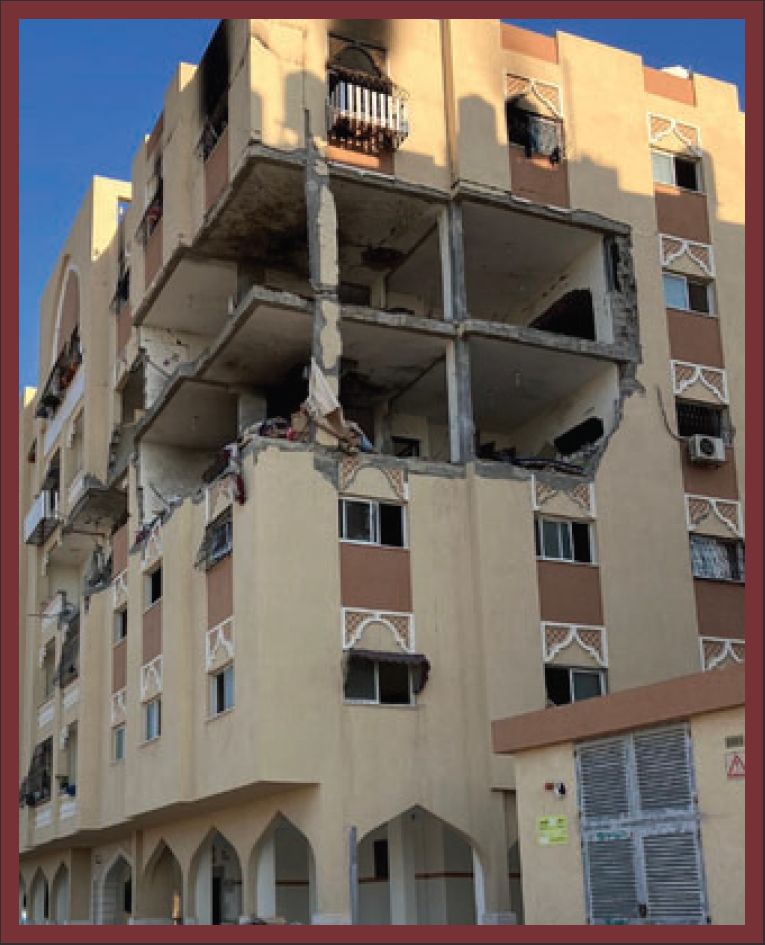
Over the next weeks, the water tap became weaker and food became scarce. We were physically and digitally isolated from the world. Solar panels were often targeted by aircraft, so even charging a device was dangerous. We fell asleep to the hum of drones that stalked us and woke to the screeching of missiles, which became most intense just before daybreak. I would count the seconds between explosions, praying each one would be the last. I thought about the people who dropped those bombs, how they were given the power to destroy without knowing who we were. Day and night, the bombardment seemed like never-ending thunder. Yet, amid it all, brave ambulances could always be heard when strikes fell nearby.
Whilst standing hungry for hours in the crowds outsidethe bakery, a thought struck me: on any other day in a normal place, I’d be in school, worried about homework and exams rather than finding our next meal. Yet, I was still learning – just different lessons.
I discovered how triumphant I felt returning to my family with a bag of bread, the gratitude of a decent meal, the joy of an hour’s internet connection, and the excitement of a pack of playing cards. In a war where our lives were frozen and soon-to-be irreversibly shattered, it was these little victories that taught me the value of life, faith, and family and reminded me that we still had a chance to live.
On November 1st, the border between Gaza and Egypt was opened for the first time but only for those holding foreign passports. Evacuation was chaotic. Families registered to leave faced separation as those could only leave if their name appeared on the list issued by the Egyptian authorities on the day. With hope, my family made the dangerous taxi ride to the border. After waiting for hours, we finally crossed the fortified border into Egypt on November 2nd – leaving behind our entire family and all our belongings that were brought in suitcases only months prior. Instead, I took with me a new understanding and the responsibility of a witness.
As I think back to leaving Gaza two years ago, reality felt (and still does feel) surreal. I had crossed through a manmade barrier and suddenly electricity, running water, and safety is normal. But it didn’t bring relief. It brought guilt and a heavy weight of powerlessness for all those we had to leave behind.
When I returned to the UK – the place where I grew up, it suddenly felt unfamiliar. I felt alienated as I tried to resume a life among those whose reality and recent experience was different to mine. Now, I go to a new school after my last one in Gaza was bombed, I make new friends without knowing if my friends in Gaza are still alive, I travel in a fuel-filled car where once…
There was a greater chance of being blown up than being rained on.
These contrasting realities are not because it all stopped but because I was transported to a different place. It is as if we live in a fake world, a dystopian society where we draw a curtain over injustices we believe are not ours to solve. want to go back to Gaza but it only exists in broken pieces on the ground. Family and friends that went missing were found under the rubble months later. It takes days to really understand a text message that informs you a person no longer exists in this world.
In December 2023, my twelve-year-old cousin Ibraheem, a boy who loved pasta and football, was torn apart by a drone strike on a street near the school his family was then sheltering in. He was murdered, (along with his cousin of the same age) by a drone controlled by a soldier far away in an office, who saw him through a screen and decided, that day, to end his life….
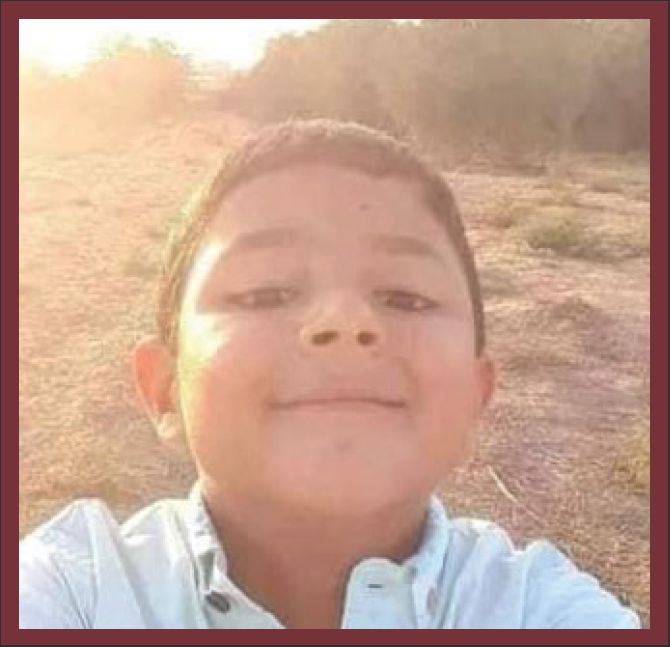
Another murder without explanation or investigation. We have lost multiple family members in such ways over the past two years and the horror continues. There is nowhere to go but live on in tents.
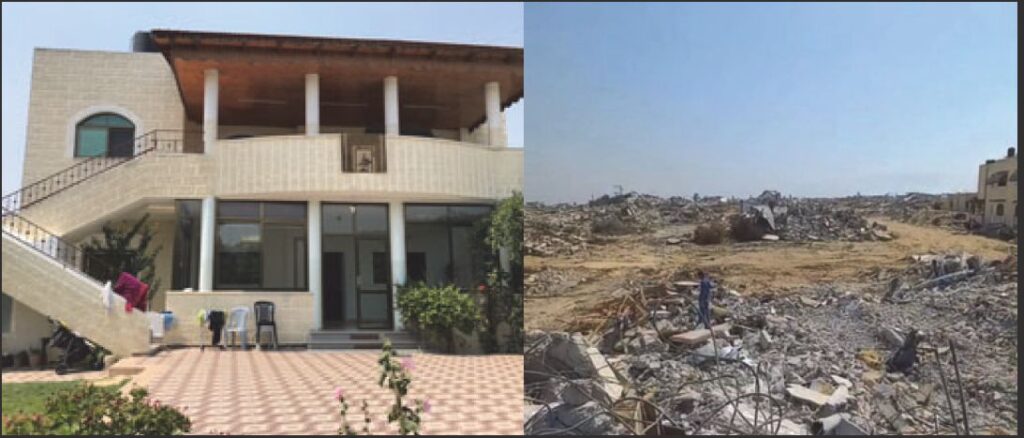
In June 2025, Israeli bulldozers destroyed our house in Gaza. Our entire neighbourhood was flattened into a ghost town of rubble. Most of Gaza is now erased and unrecognizable; one can see for miles as there are no standing buildings or trees to obscure the view.
In the UK, we have the privilege to turn off the news and we have the power to change it. Many may not think that politics affects them, but it shapes the systems we live in. We can choose to ignore it, but that is a political choice in itself. Either way, Palestinians in Gaza and around the world continue to resist erasure and hold onto their faith and humanity in the face of annihilation. We were not able to inherit our homes or freedom, so we inherited resistance and continue to demand the freedom and justice that has been denied since 1948.
The Gaza I knew is gone, and the people remaining are no longer the same. So much has been erased by bombs, bulldozers and bullets – our lives and future rewritten. But Gaza lives through us. And with faith in God, and from the memories we cherish, we will rebuild once again.
To Britain, Gaza is more than a headline, it is the consequences of our government’s historical actions.
To the World, Gaza is more than just a pile of rubble, it is a test of action and a lesson in humanity.
To History, Palestine is more than just another tragedy; it is a place and a people who did not accept injustice.
Faith, I learnt, is not in the belief that you will survive, but that your life, death and struggle means something – even if the world refuses to value it.
Gaza is a place filled with faith, extended families, students who dream, children who play within refugee camps, men and women who build not for a promise of a future, but for the hope for one – and even that is an act of resistance to erasure.
I hope one day, when the world speaks of Gaza, it won’t be of the lack of justice and humanity, but of its restoration and resilience.
Noora AbuHamad